DFT meets Bayesian inference: creating a framework for the assignment of calculated vibrational frequencies

Abstract

Volatile Organic Compounds (VOCs) are abundant in nature and play vital roles in industries such as food, fragrance, and pharmaceuticals. Aromatic VOCs like vanillin are especially valuable, driving research into sustainable chemical processes, including the conversion of biomass into high-value chemicals. Understanding the molecular structure and vibrational behavior of these compounds is essential for designing and optimising such processes. In this work, we explore how computational modelling can be used to predict and interpret vibrational spectra of VOCs. We also introduce a statistical approach using Bayesian inference to improve how theoretical predictions are matched to experimental observations. This combined strategy enhances the reliability and clarity of spectral interpretation, offering a more consistent framework for studying complex organic molecules.
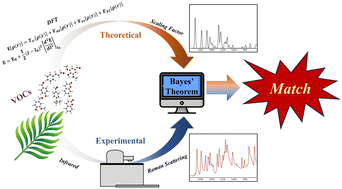
Graphical abstract: DFT meets Bayesian inference: creating a framework for the assignment of calculated vibrational frequencies

Supplementary files

Transparent peer review

To support increased transparency, we offer authors the option to publish the peer review history alongside their article.

View this article’s peer review history

Article information

Article type
Paper
Submitted
07 Oct 2025
Accepted
11 Nov 2025
First published
20 Jan 2026
This article is Open Access
Creative Commons BY-NC license

Digital Discovery, 2026, Advance Article

DFT meets Bayesian inference: creating a framework for the assignment of calculated vibrational frequencies

M. Nicolaou, H. M. Senn, E. Gibson, M. González-Jiménez and L. Vilà-Nadal, Digital Discovery, 2026, Advance Article , DOI: 10.1039/D5DD00453E

This article is licensed under a Creative Commons Attribution-NonCommercial 3.0 Unported Licence. You can use material from this article in other publications, without requesting further permission from the RSC, provided that the correct acknowledgement is given and it is not used for commercial purposes.

To request permission to reproduce material from this article in a commercial publication, please go to the Copyright Clearance Center request page.

If you are an author contributing to an RSC publication, you do not need to request permission provided correct acknowledgement is given.

If you are the author of this article, you do not need to request permission to reproduce figures and diagrams provided correct acknowledgement is given. If you want to reproduce the whole article in a third-party commercial publication (excluding your thesis/dissertation for which permission is not required) please go to the Copyright Clearance Center request page.

Read more about how to correctly acknowledge RSC content.

Social activity

Spotlight

Advertisements