


 PLATFORM UPDATE:


Efficient quantum simulation of non-adiabatic molecular dynamics with precise electronic structure

Abstract
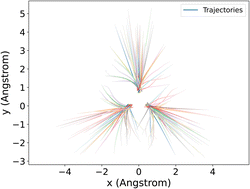
In the study of non-adiabatic chemical processes such as photocatalysis and photosynthesis, non-adiabatic molecular dynamics (NAMD) is an indispensable theoretical tool, which requires precise potential energy surfaces (PESs) of ground and excited states. Quantum computing offers promising potential for calculating PESs that are intractable for classical computers. However, its realistic application poses significant challenges to the development of quantum algorithms that are sufficiently general to enable efficient and precise PES calculations across chemical systems with diverse properties and to seamlessly adapt existing NAMD theories to quantum computing. In this work, we introduce a quantum-adapted extension to the Landau–Zener-Surface-Hopping (LZSH) NAMD. This extension incorporates curvature-driven hopping corrections that protect the population evolution while maintaining the efficiency gained from avoiding the computation of non-adiabatic couplings (NACs) and preserving the trajectory independence that enables parallelization. Furthermore, to ensure the high-precision PESs required for surface hopping dynamics, we develop a sub-microhartree-accurate PES calculation protocol. This protocol supports active space selection, enables parallel acceleration either on quantum or classical clusters, and demonstrates adaptability to diverse chemical systems—including the charged H3+ ion and the C2H4 molecule, a prototypical multi-reference benchmark. This work paves the way for practical application of quantum computing in NAMD, showcasing the potential of parallel simulation on quantum-classical heterogeneous clusters for ab initio computational chemistry.
- This article is part of the themed collection: Quantum Computing in Chemistry, Material Science and Biotechnology
 Please wait while we load your content...


