


 PLATFORM UPDATE:


Democratizing machine learning in chemistry with community-engaged test sets

Abstract
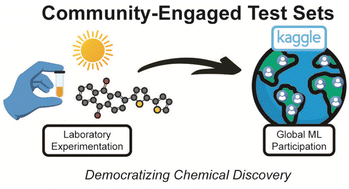
Machine learning (ML) is increasingly central to chemical discovery, yet most efforts remain confined to distributed and isolated research groups, limiting external validation and community engagement. Here, we introduce a generalizable mode of scientific outreach that couples a published study to a community-engaged test set, enabling post-publication evaluation by the broader ML community. This approach is demonstrated using a prior study on AI-guided discovery of photostable light-harvesting small molecules. After publishing an experimental dataset and in-house ML models, we leveraged automated block chemistry to synthesize nine additional light-harvesting molecules to serve as a blinded community test set. We then hosted an open Kaggle competition where we challenged the world community to outperform our best in-house predictive photostability model. In only one month, this competition received >700 submissions, including several innovative strategies that improved upon our previously published results. Given the success of this competition, we propose community-engaged test sets as a blueprint for post-publication benchmarking that democratizes access to high-quality experimental data, encourages innovative scientific engagement, and strengthens cross-disciplinary collaboration in the chemical sciences.
 Please wait while we load your content...


