


 PLATFORM UPDATE:


GEMS: a deterministic finite automaton framework for adaptive laboratory automation

Abstract
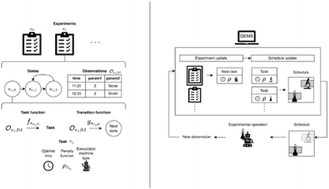
Laboratory automation increasingly requires handling complex, condition-dependent protocols that combine sequential, branching, and iterative operations. Many systems use task-oriented models, where control proceeds task to task through a predefined list. These are effective for linear, static protocols but are poorly suited to adapting to changing sample conditions or representing loops and conditional branches. We introduce the General Experimental Management System (GEMS), which instead adopts a sample-centred approach, progressing state to state, with each state defining both the operations to perform and the rules for transitioning based on observations. By formalising every experimental protocol as a partially observable Markov decision process (POMDP) and expressing its deterministic execution logic as a deterministic finite automaton (DFA), GEMS can represent heterogeneous workflow structures within a single, coherent framework and enable direct compilation into instrument-executable workflows. Its architecture includes a hierarchical experiment model, a penalty-aware scheduler combining a greedy baseline with simulated annealing refinement, and a file-based interface for instrument-agnostic control. We demonstrate GEMS in two contrasting cases: (i) fully automated Bayesian optimisation of liquid mixtures using a pipetting robot and imaging, and (ii) dynamic, long-term scheduling of multiple mammalian cell cultures executed by a LabDroid robot with autonomous imaging, passaging, medium exchange, and fault recovery. In both, GEMS maintained protocol constraints while adapting schedules in real time, showing that a state-to-state, sample-centred model provides an abstraction that maintains protocol constraints while adapting schedules in real time across heterogeneous workflows.
 Please wait while we load your content...


