


 PLATFORM UPDATE:

Mapping Bloch-Redfield dynamics into a unitary gate-based quantum algorithm

Abstract
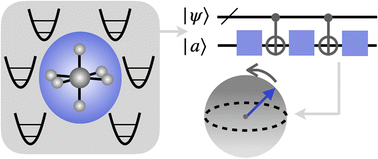
Recent progress in quantum computation has allowed for the simulation of dissipative quantum dynamics on current noisy quantum hardware. While most of these algorithms currently rely on phenomenological frameworks, microscopic approaches offer essential insights into various relaxation processes. Within classical simulation, the Bloch-Redfield equation serves as a microscopic method for modeling relaxation dynamics with applications in quantum information science and spintronics. Here, we utilize a diagonal dilation approach to map the Bloch-Redfield master equation in Liouville space into a compact set of circuits to simulate the dissipation of a spin system, akin to a dissipative process for a single molecule magnet. We demonstrate this algorithm in a variety of parameter regimes, including at different temperatures and external magnetic field strengths, on both quantum simulators and IonQ's Aria-1 quantum computer. This work broadens the scope of dissipative dynamics simulatable on quantum platforms.
- This article is part of the themed collection: Quantum Computing in Chemistry, Material Science and Biotechnology
 Please wait while we load your content...


