


 PLATFORM UPDATE:


Advancing metal organic framework and covalent organic framework design via the digital-intelligent paradigm
 *a
*a
Abstract
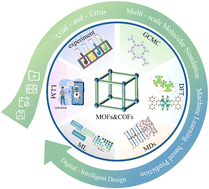
Porous framework materials—including metal–organic frameworks (MOFs) and covalent organic frameworks (COFs)—have attracted widespread attention due to their high surface areas, tunable pore structures, and diverse functionalities, enabling promising applications in gas separation, catalysis, and energy storage. However, the vast chemical configuration space and the complexity of multi-parameter synthesis conditions pose significant challenges to the rational design and controlled synthesis of materials with targeted properties. In recent years, artificial intelligence (AI), particularly machine learning (ML) and deep learning (DL), in combination with multiscale molecular simulation methods such as density functional theory (DFT), grand canonical Monte Carlo (GCMC), and molecular dynamics (MD), has emerged as a powerful tool for accelerating the screening and optimization of framework materials. This review systematically summarizes AI-assisted strategies for framework material design, focusing on data-driven prediction of synthetic routes, optimization of reaction conditions, and inverse design targeting specific functionalities. We evaluate key AI models, including interpretable tree-based algorithms and neural networks capable of modeling complex structure–property relationships, and highlight their integration with atomistic simulations to enhance predictive accuracy. Furthermore, the synergy between AI and automated experimental platforms is advancing the development of high-throughput experimentation and self-optimizing workflows, often referred to as self-driving laboratories. Several case studies illustrate the effectiveness of AI methods in identifying high-performance framework materials and achieving morphology control, particularly when leveraging the integration of experimental and simulation data. The review also discusses key challenges in AI-assisted materials design, including inconsistent data quality, limited model interpretability, and the gap between prediction and practical synthesis. Looking ahead, the continued expansion of materials databases, advances in AI algorithms, and deeper integration of domain knowledge are expected to play an increasingly vital role in framework material development, driving a paradigm shift in materials research from empirical trial-and-error to more efficient, predictive, and intelligent design.
 Please wait while we load your content...


