


 PLATFORM UPDATE:


Computer vision for high-throughput materials synthesis: a tutorial for experimentalists

Abstract
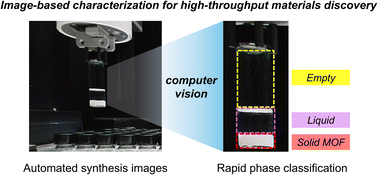
Advances in high-throughput instrumentation and laboratory automation are revolutionizing materials synthesis by enabling the rapid generation of large libraries of novel materials. However, efficient characterization of these synthetic libraries remains a significant bottleneck in the discovery of new materials. Traditional characterization methods are often limited to sequential analysis, making them time-intensive and cost-prohibitive when applied to large sample sets. In the same way that chemists interpret visual indicators to identify promising samples, computer vision (CV) is an efficient approach to accelerate materials characterization across varying scales when visual cues are present. CV is particularly useful in high-throughput synthesis and characterization workflows, as these techniques can be rapid, scalable, and cost-effective. Although there is a set of growing examples in the literature, we have found a lack of resources where newcomers interested in the field could get a hold of a practical way to get started. Here, we aim to fill that identified gap and present a structured tutorial for experimentalists to integrate computer vision into high-throughput materials research, providing a detailed roadmap from data collection to model validation. Specifically, we describe the hardware and software stack required for deploying CV in materials characterization, including image acquisition, annotation strategies, model training, and performance evaluation. As a case study, we demonstrate the implementation of a CV workflow within a high-throughput materials synthesis and characterization platform to investigate the crystallization of metal–organic frameworks (MOFs). By outlining key challenges and best practices, this tutorial aims to equip chemists and materials scientists with the necessary tools to harness CV for accelerating materials discovery.
 Please wait while we load your content...


