


 PLATFORM UPDATE:


Real-time cell sorting with scalable in situ FPGA-accelerated deep learning

Abstract
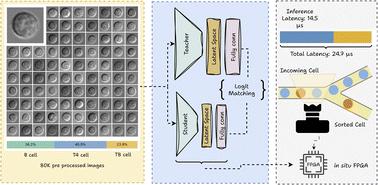
Precise cell classification is essential in biomedical diagnostics and therapeutic monitoring, particularly for identifying diverse cell types involved in various diseases. Traditional cell classification methods, such as flow cytometry, depend on molecular labeling, which is often costly, time-intensive, and can alter cell integrity. Real-time microfluidic sorters also impose a sub-ms decision window that existing machine-learning pipelines cannot meet. To overcome these limitations, we present a label-free machine learning framework for cell classification, designed for real-time sorting applications using bright-field microscopy images. This approach leverages a teacher–student model architecture enhanced by knowledge distillation, achieving high efficiency and scalability across different cell types. Demonstrated through a use case of classifying lymphocyte subsets, our framework accurately classifies T4, T8, and B cell types with a dataset of 80 000 pre-processed images, released publicly as the LymphoMNIST package for reproducible benchmarking. Our teacher model attained 98% accuracy in differentiating T4 cells from B cells and 93% accuracy in zero-shot classification between T8 and B cells. Remarkably, our student model operates with only 5682 parameters (∼0.02% of the teacher, a 5000-fold reduction), enabling field-programmable gate array (FPGA) deployment. Implemented directly on the frame-grabber FPGA as the first demonstration of in situ deep learning in this setting, the student model achieves an ultra-low inference latency of just 14.5 µs and a complete cell detection-to-sorting trigger time of 24.7 µs, delivering 12× and 40× improvements over the previous state of the art in inference and total latency, respectively, while preserving accuracy comparable to the teacher model. This framework establishes the first sub-25 µs ML benchmark for label-free cytometry and provides an open, cost-effective blueprint for upgrading existing imaging sorters.
 Please wait while we load your content...


