


 PLATFORM UPDATE:


Evaluating the transfer learning from metals to oxides with GAME-Net-Ox

Abstract
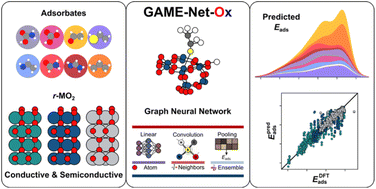
The estimation of the strength of the bond of adsorbates on the surface is key to the design of novel materials for heterogeneous catalysis. Machine learning (ML) methodologies have proven effective in rapidly and accurately evaluating adsorption energies on transition metal surfaces. However, the complexity of metal oxides and their diverse adsorbate–catalyst interactions hinder the sound transfer of ML approaches to these catalytically relevant materials. To address this challenge, we have evaluated the transferability of GAME-Net, a graph neural network developed for transition metals, by following an approach of increasing complexity, leading to GAME-Net-Ox. A density functional theory dataset was built with organic molecules on conductive (IrO2 and RuO2) and semiconductive (TiO2) rutile oxides to evaluate GAME-Net's transferability. While the original GAME-Net failed to directly generalize between metals and metal oxides, GAME-Net-Ox trained exclusively on oxides achieved high accuracy (MAE = 0.16 eV) and both families of materials can be treated in GAME-Net-Ox with the same accuracy (MAE = 0.16 eV). This work demonstrates the adaptability of the GAME-Net architecture, enabling the screening of adsorbates on metal oxides, materials with complex electronic properties.
 Please wait while we load your content...


