


 PLATFORM UPDATE:


Deep learning-enabled discovery of low-melting-point ionic liquids

Abstract
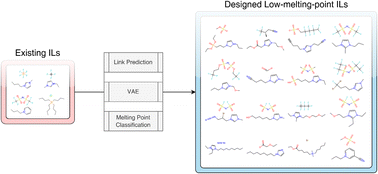
Ionic liquids (ILs) are salts that are liquids at ambient conditions (typically below 373 K) and are known for their many unique properties, including low volatility and high thermal stability. Despite the promise of ILs, their targeted design is challenging for several reasons, including (i) the vast number of candidate ions that could be synthesised as components of an IL, (ii) the lack of predictive methods to determine what ion combinations will yield ILs with desired melting points, and (iii) experimentally known ILs possess limited chemical diversity. In this work, we present a data-driven framework for designing novel low-melting-point ILs. We model ILs as bipartite graphs and apply a link prediction algorithm to identify promising cation–anion pairs, expanding the collected IL database more than 30-fold, while prioritising low melting points. To further explore chemical space, we trained variational auto-encoders (VAEs) to generate new IL candidates through learning a latent space that enables modelling the data distribution. A thermodynamics-inspired classification model is subsequently employed to filter out ILs predicted to melt above 373 K. Finally, molecular dynamics simulations validate our approach, confirming that 18 out of 20 generated ILs have melting points below 373 K.
 Please wait while we load your content...


