


 PLATFORM UPDATE:


Deep learning based SEM image analysis for predicting ionic conductivity in LiZr2(PO4)3-based solid electrolytes

Abstract
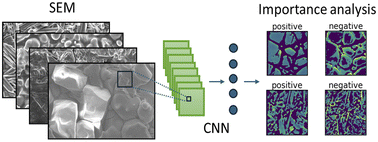
Lithium-ion-conductive oxide materials have attracted considerable attention as solid electrolytes for all-solid-state batteries. In particular, LiZr2(PO4)3-related compounds are promising for high-energy-density devices using metallic lithium anodes, but further enhancement of their ionic conductivity is requested. In general, Li-ion conductivity is influenced by mechanisms operating on two distinct length scales. At the atomic scale, point defects and the associated migration barriers within the crystal lattice are critical, whereas at the micrometre scale, porosity and grain-boundary characteristics that develop during sintering become the dominant factors. These coupled effects make systematic optimization of conductivity difficult. In paticular, microstructural analysis has often relied on researchers' intuitive interpretation of scanning electron microscopy (SEM) images. Here, we apply a convolutional neural network (CNN), a deep-learning approach that has seen rapid advances in image analysis, to SEM images of LiZr2(PO4)3-based electrolytes. By combining image-derived features with conventional vector descriptors (composition, sintering parameters, etc.), our regression model achieved an R2 of 0.871. Furthermore, visual-interpretability analysis of the trained CNN revealed that grain-boundary regions were highlighted as low-conductivity areas. These findings demonstrate that deep-learning-based SEM analysis enables automated, quantitative evaluation of ionic conductivity and offers a powerful tool for accelerating the development of solid electrolyte materials.
 Please wait while we load your content...


