


 PLATFORM UPDATE:


Shedding light on the copper-catalysed diboron(4) reduction of nitrous oxide

Abstract
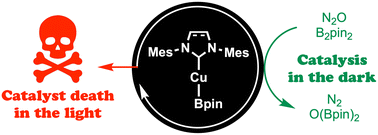
Catalytic deoxygenation of the potent greenhouse gas and ozone-depleting agent N2O mediated by NHC-ligated copper(I) boryl complexes has been examined under a variety of reaction conditions, including different diboron(4) reducing agents, and benchmarked against a rhodium(I) system. While unstable and decomposing rapidly in light, complexes of SIMes and IMes deliver the highest catalytic activity in combination with B2pin2 as the reducing agent when performed in the dark using THF as the solvent, achieving ∼2000 TONs over 20 h at room temperature under 1 bar gauge of N2O pressure. DFT-based computational analysis corroborates a mechanism involving reaction of the copper(I) boryl with N2O by O-atom insertion into the Cu–B bond (via initial κN-coordinaton) followed by sigma-bond metathesis between the resulting boroxide derivative and diboron(4) reducing agent, with the relative barriers nuanced by the nature of the supporting NHC ligand and solvent employed.
 Please wait while we load your content...


