


 PLATFORM UPDATE:


Design of a cellulose-derived Cu(ii) catalyst for efficient dehydrogenative synthesis of pyrimidines from renewable primary alcohols

Abstract
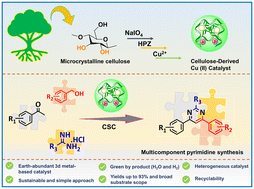
In this study, a cellulose-derived Schiff base (CSB) was developed as a renewable support for immobilizing Cu(II), creating a robust and recyclable catalytic system with excellent activity in green synthesis transformations. The resulting cellulose-derived Schiff base–Cu(II) complex (CSC) showed remarkable efficiency as a heterogeneous catalyst for the sustainable, eco-friendly, and practical multi-component synthesis (MCS) of pyrimidines. The catalytic process occurs via acceptorless dehydrogenation of benzyl alcohols. Detailed characterization confirmed strong coordination of Cu(II) within the CSB matrix, providing a stable framework that supports the catalytic cycle and hydride transfer mechanism. The reaction proceeds efficiently with various primary alcohols, producing molecular hydrogen as the only by-product, thus ensuring excellent atom economy. The CSC catalyst demonstrated high stability and could be easily recovered and reused over multiple catalytic cycles with minimal loss of activity. This work highlights the potential of cellulose-derived Schiff base frameworks as versatile platforms for developing sustainable transition-metal catalysts that enable environmentally friendly heterocyclic syntheses.
 Please wait while we load your content...


