


 PLATFORM UPDATE:


Activation of isocyanates with gold: towards Au-catalyzed C–H amidation of pyrroles

Abstract
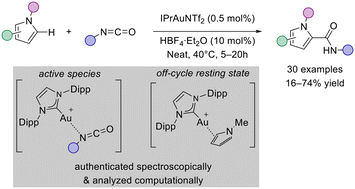
The intermolecular hydroarylation of isocyanates with pyrroles was found to be efficiently catalyzed by the Au(I) complex IPrAuNTf2 (IPr = N,N′-bis(2,6-diisopropylphenyl)-imidazol-2-ylidene). The transformation tolerates electron-withdrawing and electron-donating substituents both at the heterocycle and the isocyanate. It affords secondary aromatic amides in a single step under mild conditions with catalyst loadings down to 0.5 mol%. The reaction proceeds via coordination of the isocyanate to gold and outer-sphere nucleophilic attack of the heterocycle. Several gold(I) isocyanate adducts were authenticated by multinuclear NMR spectroscopy at low temperatures. 15N-labeling of the organic fragment allowed us to observe a deshielding of the 13C NMR N![[double bond, length as m-dash]](https://www.rsc.org/images/entities/char_e001.gif) CO signal and a decrease of the associated 1JCN coupling constant upon coordination to gold. With further support from density functional theory (DFT) calculations, the ground state was assigned to an η1-N-coordination isomer. The corresponding η1-O-adduct lies ca. 8–11 kcal mol−1 higher in energy. A gold(I) π-adduct involving N-methyl pyrrole as the substrate was also authenticated experimentally, including by X-ray crystallography. The latter species is involved as an off-cycle resting state in the catalytic transformation.
CO signal and a decrease of the associated 1JCN coupling constant upon coordination to gold. With further support from density functional theory (DFT) calculations, the ground state was assigned to an η1-N-coordination isomer. The corresponding η1-O-adduct lies ca. 8–11 kcal mol−1 higher in energy. A gold(I) π-adduct involving N-methyl pyrrole as the substrate was also authenticated experimentally, including by X-ray crystallography. The latter species is involved as an off-cycle resting state in the catalytic transformation.
 Please wait while we load your content...


