


 PLATFORM UPDATE:


Design of Pt-based pseudo-binary intermetallic catalysts for dry reforming of propane using CO2

Abstract
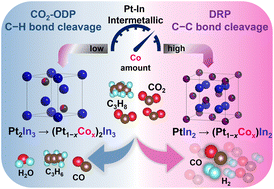
The utilization of CO2 along with commercial light alkane dehydrogenation processes has attracted much attention due to the high demand for the reduction of CO2 in the atmosphere caused by human activities and the shale gas revolution. Compared with the widely studied dry reforming of methane, converting propane to syngas using CO2 is more beneficial in terms of easy handling, energy saving and CO2 utilization efficiency. However, the design of an efficient and stable catalyst remains a challenge due to the difficulty of activating CO2 and propane simultaneously. Herein, we report a multifunctional catalyst with a pseudo-binary alloy structure, Pt2CoIn3/CeO2, which exhibits high activity for C–C bond cleavage and efficient CO2 activation. As a result, it delivers high CO selectivity and strong coke resistance, maintaining stable performance over 100 h of reaction. Detailed X-ray analyses revealed that the intermetallic structure varies with the Co content, which in turn tunes both the C3H6 adsorptivity and CO2 activation capability. By combining intermediate surface-reaction studies with density functional theory calculations, we identify the difference in the energy barriers for C3H6 decomposition and C3H6 desorption as a key descriptor governing product selectivity. These findings provide a new design concept for multimetallic catalysts that can be extended to a broad range of selective conversion reactions.
- This article is part of the themed collections: Catalysis Science & Technology Open Access Spotlight 2026 and Catalysis Science & Technology Pioneering Investigators
 Please wait while we load your content...


