


 PLATFORM UPDATE:


Regulation of Fe/Co–N–C catalysts by hydrogen-assisted calcination for enhanced alkaline oxygen reduction
 a
and
Xuefeng
Ren
*a
a
and
Xuefeng
Ren
*a
Abstract
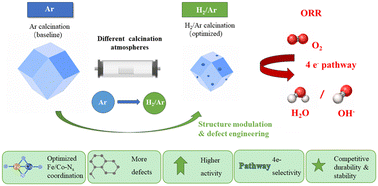
Energy demand and environmental pollution have driven the growth in fuel cells; however, the cathode oxygen reduction reaction remains the key bottleneck limiting efficiency improvements. Herein, an electrocatalyst was synthesized using a straightforward, efficient approach in which 5 vol% H2 was introduced into the calcination atmosphere to regulate the zeolitic imidazolate framework-8 (ZIF-8)-derived FeCo–NC. SEM observations confirmed that both the Ar-treated FeCo–NC and the H2/Ar-treated FeCo–NC–V retained the rhombic dodecahedral morphology inherited from ZIF-8. Compared with FeCo–NC, FeCo–NC–V exhibited a reduced average particle size together with H2/Ar-induced modulation of the local coordination environment, defect structure, and short-range ordering within carbon microcrystallites. This was supported by sharper selected-area electron diffraction (SAED) rings and discernible (002) fringes with an expanded interlayer spacing of 0.36 nm along with a higher Raman defect ratio (AD/AG = 3.13) than that of FeCo–NC (2.89). In 0.1 M KOH, FeCo–NC–V achieved an oxygen reduction reaction (ORR) half-wave potential (E1/2) of 0.89 V (vs. RHE) and limiting current density of 6.02 mA cm−2, exceeding that of Pt/C (0.86 V; 5.32 mA cm−2). The kinetics were also improved, as reflected by a smaller Tafel slope of 123.26 mV dec−1 compared with 132.61 mV dec−1 for FeCo–NC. Moreover, the intrinsic activity was enhanced, with a relative turnover frequency (TOF) of 1.48 at 0.80 V (vs. RHE). Durability is further demonstrated by modest E1/2 losses of 20.4 mV after 5000 cycles and 31.4 mV after 10 000 cycles along with 84.6% current retention at 60 000 s, which exceeds that of Pt/C (62.9%). Overall, hydrogen-assisted calcination offers a practical strategy to regulate defect formation and the local coordination environment, thereby enabling the construction of high-performance, non-precious-metal ORR cathode catalysts. This approach balances ORR activity and operational durability in alkaline electrolyte and may guide the design of advanced ORR electrocatalysts derived from metal–organic frameworks (MOFs).
 Please wait while we load your content...


