


 PLATFORM UPDATE:


Nickel catalysts in the hydrogenation of benzyltoluene using impure hydrogen streams
 a
and
Patrick
Schühle
*a
a
and
Patrick
Schühle
*a
Abstract
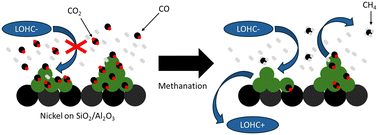
Biomass-derived hydrogen is frequently contaminated with CO and CO2, which limits its direct utilization in downstream applications. Cyclic hydrogenation/dehydrogenation of liquid organic hydrogen carriers (LOHCs) such as benzyltoluene (BT) provides a pathway to simultaneously store hydrogen and purify such “low-grade” hydrogen feeds. In this context, Ni-based catalysts are particularly attractive because they can hydrogenate aromatic systems under CO-containing atmospheres while representing a relatively cheap alternative to noble metal catalysts. Here, we systematically investigate BT hydrogenation over a commercial Ni/Al2O3/SiO2 catalyst under process-relevant LOHC conditions (T = 170–230 °C, p = 10–50 bar) in the presence of CO (0–6%) and demonstrate that BT conversion remains feasible even at high CO levels, while the hydrogenation rate decreases due to competitive CO adsorption. Time-resolved analysis of both gas- and liquid-phase compositions further reveals CO methanation during BT hydrogenation, indicating that both reactions proceed in parallel while competing for active sites. By varying temperature and total pressure, the balance between BT hydrogenation and methanation can be steered, with 230 °C and 50 bar identified as the most favorable conditions for efficient BT hydrogenation under CO presence. In addition, introducing CO2 at biomass-typical concentrations (30 vol%) shows that it likewise adsorbs competitively on Ni and is also converted to methane. Collectively, these results highlight Ni-based catalysts as a robust catalyst for mixed-gas hydrogenation and LOHC-enabled purification/storage of biogenic hydrogen, while underscoring an inherent trade-off between competitive (co-)methanation, that consumes a fraction of hydrogen as CH4 that cannot be recovered upon LOHC dehydrogenation, yet constitutes an energy-dense coproduct stream that may be valorized.
- This article is part of the themed collection: Catalysis Science & Technology Open Access Spotlight 2026
 Please wait while we load your content...


