


 PLATFORM UPDATE:


Solvent-free recycling of polystyrene waste into valuable mono-aromatics over a Ni/NbOx catalyst
 b
and
Xiang
Wang
*a
b
and
Xiang
Wang
*a
Abstract
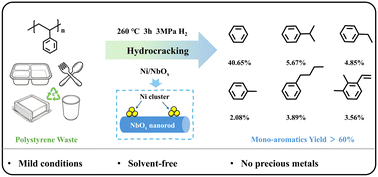
The catalytic upcycling of polystyrene (PS) waste into valuable aromatic chemicals can mitigate plastic pollution and reduce dependence on fossil-derived aromatics; however, its hydroconversion into mono-aromatics remains challenging due to the intrinsic stability of the C–C bonds in the polymer backbone and the competitive hydrogenation of aromatic rings under hydrogen atmospheres. Herein, we report a solvent-free catalytic strategy for the efficient upcycling of PS into mono-aromatics over a bifunctional Ni/NbOx catalyst. Under relatively mild conditions, i.e. 260 °C and 3 MPa H2, a 1 wt% Ni/NbOx catalyst achieves complete PS conversion within 3 h without a solvent, delivering a liquid yield above 90% and a mono-aromatics selectivity of 60.7%, corresponding to a mono-aromatics formation rate of 2.02 gmono-aromatics gcat−1 h−1. Comparison with a physical mixture of Ni + NbOx indicates that the close contact between Ni and NbOx in Ni/NbOx enhances hydrogen spillover, thus resulting in a higher activity for the hydrocracking of polystyrene into mono-aromatics. The Ni/NbOx catalyst exhibits good recyclability and applicability to real-world and mixed plastic wastes, providing a cost-effective and scalable catalytic approach for the sustainable upgrading of polystyrene waste into valuable aromatic chemicals.
 Please wait while we load your content...


