


 PLATFORM UPDATE:


Cu encapsulated in hierarchical MFI zeolites for ethanol dehydrogenation to acetaldehyde

Abstract
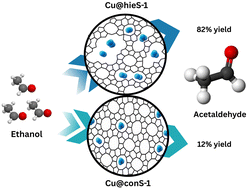
In this contribution, we report the design of Cu nanoparticles encapsulated within both hierarchical and conventional MFI frameworks for the dehydrogenation of ethanol to acetaldehyde. The encapsulated catalysts were successfully synthesized via a hydrothermal method, using tetrabutylammonium hydroxide (TBAOH) and tetrapropylammonium hydroxide (TPAOH) as structure-directing agents (SDAs) for hierarchical and conventional frameworks, respectively. Characterization results showed that the hierarchical silicalite-1 zeolite (Cu@hieS-1) exhibited the simultaneous presence of mesopores and uniform Cu nanoparticles (∼2.3 nm), with high Cu dispersion (82.6%), thereby significantly improving active-site accessibility and reducing diffusion path lengths, eventually enhancing catalytic efficiency. Catalytic testing demonstrated that Cu@hieS-1 achieved 96% ethanol conversion and 82% acetaldehyde yield at 400 °C, outperforming conventional zeolites (15% ethanol conversion and 12% acetaldehyde yield). The reason for the improved catalytic activity over Cu@hieS-1 compared to the conventional ones relates to the fact that Cu@hieS-1 contains a higher proportion of Cu+ species compared with the others, eventually leading to promoting acetaldehyde formation. Additionally, hierarchical zeolites exhibited enhanced catalytic stability, maintaining ∼80% conversion and 82% acetaldehyde yield. This work illustrates the benefits of the encapsulated catalyst in optimizing catalytic performances for sustainable acetaldehyde production.
- This article is part of the themed collection: Advanced Catalytic Materials for Energy and Environmental Applications
 Please wait while we load your content...


