


The role of distinct metal cocatalysts in tuning β-ZrNBr for diverse photocatalytic applications
 *b
*b
Abstract
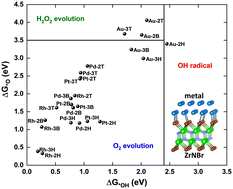
The deposition of suitable metal cocatalysts onto semiconductor surfaces is a highly effective strategy for enhancing photocatalytic performance. However, the underlying microscopic mechanisms that dictate the optimal choice of metal for a specific semiconductor remain insufficiently understood. This work aims to establish a structure–property relationship for metal-decorated β-ZrNBr, focusing on the fundamental question of why certain metals excel as cocatalysts for particular photocatalytic reactions. We systematically constructed M/ZrNBr (M = Rh, Pd, Pt, Au) heterostructures with controlled metal layer thickness (1–3 layers) to probe their structural stability, electronic structures, and performances in the photocatalytic hydrogen evolution reaction (HER) and water oxidation reaction. Density functional theory (DFT) calculations and ab initio molecular dynamics (AIMD) simulations reveal that all heterostructures possess robust structural and thermal stability. Electronic structure analysis shows that Rh, Pd, and Pt induce metallization of the ZrNBr surface, whereas Au/ZrNBr preserves its semiconducting character. For the HER, multi-layer Rh and Pd systems exhibit near-optimal hydrogen adsorption free energies (|ΔGH| ≈ 0), suggesting their potential as alternatives to Pt. Systematic investigation of water oxidation reveals that Au-2H favors ˙OH evolution, while Au-2T, Au-2B, and Au-3T are selective for H2O2 production. Most other surfaces favor O2 evolution, with Au-3B and Au-3H near the triple-phase intersection showing potential for multiple pathways, establishing Au as the most promising metal for H2O2 evolution, which is consistent with experiments. For oxygen evolution reaction (OER), overpotentials (η4e−) range from 0.26 V to 1.83 V, with a clear site-dependent trend on Rh, Pd, and Pt-modified surfaces: top site < bridge site < hollow site, reflecting progressively increasing thermodynamic barriers along this series. This study provides atomic-scale insights into the role of metal identity and thickness in tuning catalytic performance, offering a solid theoretical foundation for designing high-performance β-ZrNBr-based photocatalytic systems.
 Please wait while we load your content...


