


 PLATFORM UPDATE:


Hydrogenation of cinnamaldehyde by platinum supported on 2D and 3D transition metal sulfides
 a
Iryna
Danylo,
a
Lukas
Kolacny,
a
Berke
Sevemez,
a
Jan
Luxa,
b
Martin
Vesely
a
and
Martina
Pitinova
*a
a
Iryna
Danylo,
a
Lukas
Kolacny,
a
Berke
Sevemez,
a
Jan
Luxa,
b
Martin
Vesely
a
and
Martina
Pitinova
*a
Abstract
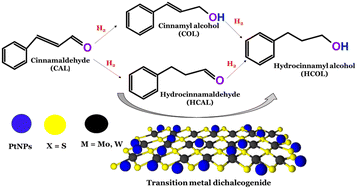
The selective hydrogenation of cinnamaldehyde (CAL), a model α,β-unsaturated aldehyde, yields valuable products such as cinnamyl alcohol (COL) and hydrocinnamaldehyde (HCAL). Pt-based catalysts supported on transition metal dichalcogenides (MoS2, WS2, and their composite) in bulk forms and their exfoliated counterparts were synthesized using microwave-assisted and wet impregnation methods. Characterization (SEM/EDS, TEM, XRF, XRD, and BET) confirmed ∼9 wt% Pt loading, preserved layered structures, and well-dispersed nanoparticles. Catalysts based on 2D supports provided finer Pt dispersion (2–6 nm), with microwave synthesis yielding smaller, more uniform particles, especially in the Mo–W composite. Catalytic testing demonstrated that both activity and selectivity were strongly influenced by the support composition and morphology, with the 2D Mo–W composite outperforming MoS2 and WS2. All catalysts predominantly promoted selective C![[double bond, length as m-dash]](https://www.rsc.org/images/entities/char_e001.gif) O hydrogenation to COL, while HCAL and HCOL remained minor products. The best performance was achieved with Pt supported on the 2D Mo–W–S composite prepared by microwave-assisted synthesis, delivering 75% CAL conversion with a COL selectivity and yield of 64% and 48%, respectively, achieved within 6 h.
O hydrogenation to COL, while HCAL and HCOL remained minor products. The best performance was achieved with Pt supported on the 2D Mo–W–S composite prepared by microwave-assisted synthesis, delivering 75% CAL conversion with a COL selectivity and yield of 64% and 48%, respectively, achieved within 6 h.
- This article is part of the themed collection: Catalysis Science & Technology Open Access Spotlight 2026
 Please wait while we load your content...


