


The effects of hydrothermal aging on NH3 oxidation over high-loading Cu-SSZ-13 catalysts: an experimental and kinetic modelling study
 acd
Gurong
Shen
*b
acd
Gurong
Shen
*b
Abstract
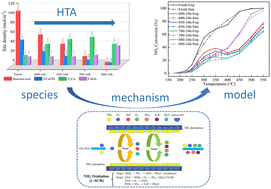
This study investigates how hydrothermal aging affects NH3 oxidation performance in high-loading Cu-SSZ-13 catalysts, aiming to reveal the intrinsic relationship between Cu species and catalytic activity. A series of catalysts, after being subjected to various hydrothermal aging conditions, were characterised using NH3-TPD, NO + NH3-titration, H2-TPR, and NH3 oxidation tests to quantify the evolution of Brønsted acid sites and key Cu species (ZCuOH, Z2Cu, and CuOx). The results indicate that ZCuOH serves as the dominant active site in the low-temperature region, with a distinct linear correlation between its content and the low-temperature NH3 oxidation activity. In the high-temperature region, both ZCuOH and CuOx contribute to the NH3 oxidation activity, while Z2Cu exhibits little contribution. Based on the internal selective catalytic reduction (i-SCR) mechanism, a kinetic model was established that successfully simulates the experimental trends of NH3 conversion and NO concentration in both the low- and high-temperature regions. The results confirm that hydrothermal aging influences the two-step NH3 oxidation process (NH3 → NO and NO + NH3 → N2) by altering the distribution of Cu species. Notably, the model incorporates CuOx sites, overcoming the limitations of previous models in simulating high Cu loading catalyst samples. This work confirms the reliability of the NH3 oxidation kinetic model and the rationality of the i-SCR mechanism, providing valuable insights for optimising the hydrothermal stability and catalytic performance of Cu-SSZ-13 catalysts.
 Please wait while we load your content...


