


 PLATFORM UPDATE:


Ruthenium hydride catalyzed α-alkylation of ketones with primary alcohols for access to bioactive molecules using the borrowing-hydrogen approach

Abstract
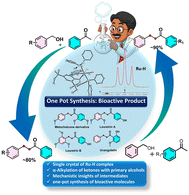
A new ruthenium hydride complex, [L1RuH(CO)(PPh3)2] (1), featuring the 2-(2H-benzo[D][1,2,3]triazol-2-yl)-4,6-di-tert-pentylphenol (L1) ligand, has been synthesized and thoroughly characterized by UV-visible, infrared, NMR, and HRMS spectrometry. The molecular structure was confirmed by single-crystal X-ray diffraction analysis. Complex 1 demonstrated high catalytic efficiency (∼70–92% yield) in the α-alkylation of ketones with primary alcohols under mild conditions using the borrowing-hydrogen method. A detailed mechanistic investigation was also performed to understand the catalytic process, and the intermediate species were confirmed by HRMS spectrometry. The effectiveness of catalyst 1 is demonstrated by enabling the synthesis of several valuable bioactive molecules, including loureirin A, loureirin B, uvangoletin, and 1-(2,4-dimethoxyphenyl)-3-(4-methoxyphenyl)-1-propanone.
 Please wait while we load your content...


