


 PLATFORM UPDATE:


Tangled effects of CuCl precursor and Zn and Sn promoters used for the direct synthesis of methylchlorosilanes
 b
S.
Loridant
*a
b
S.
Loridant
*a
Abstract
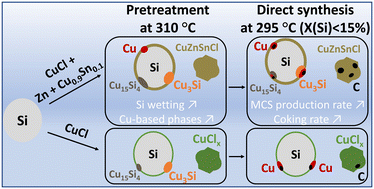
In this work, the effects of CuCl precursor and Zn and Sn additives on the formation of Cu-based metallic phases as well as on catalytic performance and coke formation were investigated during the early stage of methylchlorosilane synthesis. The Cu3Si catalytic active phase, as well as Cu15Si4 and Cu, is formed during pretreatment at 310 °C. Addition of Zn and Cu0.9Sn0.1 was shown to accelerate their formation probably through the wetting of Si particles by mixed chlorides. Furthermore, residual chloride particles were observed both for promoted and unpromoted masses. It was confirmed that Zn and Sn promote the dimethyldichlorosilane formation rate at 295 °C but also clearly showed that they favour CH3Cl cracking. Coke containing disordered graphite, readily detected by Raman spectroscopy, was preferentially formed on residual chloride particles. CH3Cl cracking could be favoured by the presence of Zn and Sn within such particles. Therefore, the tangled positive and negative effects of Zn and Sn ‘promoters’ as well as of the CuCl precursor highlight the need to carefully optimize their respective amounts in an industrial process.
- This article is part of the themed collection: Catalysis Science & Technology Open Access Spotlight 2026
 Please wait while we load your content...


