


 PLATFORM UPDATE:


Synergistic effects of oxygen vacancies and the Schottky junction in Ni/CeNiO3−x catalysts for photothermal CO2 methanation
 *ac
*ac
Abstract
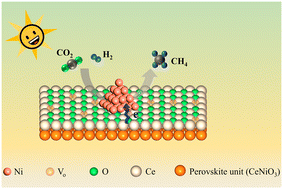
In response to the increasingly severe pressure for CO2 emission reduction, the development of efficient, low-temperature CO2 conversion technologies is of great significance. This study focuses on the serious carrier recombination issue in photothermal catalytic CO2 methanation and innovatively constructs Ni/CeNiO3 and Ni/CeNiO3−x catalysts with different oxygen vacancy concentrations by regulating the oxygen vacancy concentration in CeNiO3 precursors. The results show that under 250 °C photothermal conditions, Ni/CeNiO3−x achieves a CO2 conversion rate of 91.2% and CH4 selectivity of 93.1%, with a methane production rate of 163.7 mmol g−1 h−1, significantly outperforming the Ni/CeNiO3 reference catalyst. Mechanistic studies reveal that the Schottky junction at the Ni–CeO2 interface promotes directional migration of photogenerated electrons and suppresses their recombination, while the abundant oxygen vacancies provide increased electron trapping capacity, thereby functioning to enhance CO2 adsorption and activation on the material surface. The synergistic effect of these two factors significantly improves the photothermal catalytic performance. This study provides new insights for designing efficient and stable Schottky junction photothermal catalysts.
- This article is part of the themed collection: Celebrating International Women’s Day 2026: Women in Catalysis
 Please wait while we load your content...


