


 PLATFORM UPDATE:


Cryogenic electron tomography reveals the mesoporous structure evolution during γ-Al2O3 supported Mo and MoNiP catalyst formation

Abstract
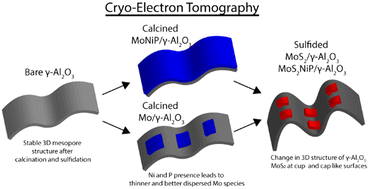
Heterogeneous catalysts play a central role in numerous industrially and societally relevant processes. Despite the widespread use, a detailed understanding of the support mesoporosity and its transformation during catalyst preparation remains incomplete. In this study, cryogenic electron tomography (cryo-ET) was utilized to resolve the 3D mesopore structure of γ-Al2O3 and to assess structural changes induced by oxidic Mo and MoNiP deposition and sulfidation during the preparation of hydrodesulfurization (HDS) catalysts. The intrinsic γ-Al2O3 surface and mesopore structure remained largely stable throughout calcination and sulfidation, although cryo-ET revealed subtle variations inaccessible to bulk characterization techniques. Oxidic Mo deposition introduced slight increases in tortuosity and surface corrugation, whereas oxidic MoNiP deposition induced minimal changes. Compared to the bare support, sulfidation of both Mo and MoNiP supported on γ-Al2O3 resulted in more tortuous mesopores and a more corrugated surface. Careful segmentation enabled separate analysis of γ-Al2O3 and MoS2 slabs, revealing that, for both catalysts, the γ-Al2O3 exhibited similar surface and mesopore modifications, and there were no significant differences in MoS2 slab morphology. Corrected Mo loadings derived from cryo-ET aligned with bulk measurements, validating the approach. These findings provide a comprehensive 3D perspective on mesopore stability during catalyst preparation and highlight the need for higher-resolution imaging and advanced 3D analysis to establish robust structure–function correlations.
- This article is part of the themed collection: Catalysis Science & Technology Open Access Spotlight 2026
 Please wait while we load your content...


