


 PLATFORM UPDATE:


Recent trends in palladium-catalysed isocyanide chemistry: from heterocyclic frameworks to mechanistic understanding
 *a
*a
Abstract
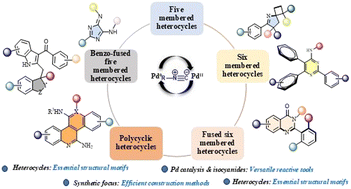
Heterocycles represent a fundamental class of structural motifs that are integral to a wide array of pharmaceuticals, natural products, and functional organic materials, owing to their unique chemical and biological properties. The development of efficient methods for constructing these scaffolds remains a central focus in modern synthetic chemistry. Among the various strategies, palladium-catalyzed reactions have emerged as highly versatile tools, enabling selective C–H functionalization and facilitating the formation of complex molecular architectures through both inter- and intramolecular pathways. Additionally, isocyanides have attracted considerable attention as reagents due to their ambident reactivity, which allows them to act simultaneously as electrophiles and nucleophiles, making them exceptionally useful in multicomponent and cascade reactions. In recent years, Pd-catalyzed isocyanide insertion cascade reactions have witnessed significant advancements, demonstrating remarkable efficiency and broad substrate scope in the synthesis of diverse heterocyclic frameworks. This review aims to provide an overview of the recent progress in Pd-catalysed isocyanide insertion strategies, with a focus on the construction of five-membered, six-membered, and fused heterocyclic systems, highlighting their mechanistic aspects, synthetic utility, and potential applications in medicinal and materials chemistry.
- This article is part of the themed collection: Catalysis Science & Technology Open Access Spotlight 2026
 Please wait while we load your content...


