


 PLATFORM UPDATE:


Disentangling an extended network of Rh complexes in supported ionic liquid phase (SILP) catalysts for hydroformylation: a combined in situ IRAS and DFT study

Abstract
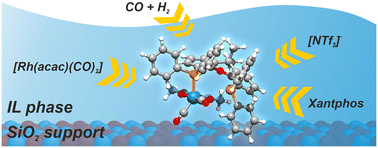
Ionic liquids (ILs) serve as highly effective thin-film coatings in supported ionic liquid phase (SILP) systems, combining the molecular definition and high activity of homogeneous catalysts with the facile product recovery and recyclability inherent in heterogeneous catalysts. This study investigates a SILP system composed of acetylacetonato(dicarbonyl)rhodium(I) [Rh(acac)(CO)2], 4,5-bis(diphenylphosphino)-9,9-dimethyl-xanthene (xantphos, xp), 1-butyl-3-methylimidazolium bis(trifluoromethylsulfonyl)imide [C4C1Im][NTf2], and SiO2, which is active towards the hydroformylation of ethylene. We employ in situ infrared (IR) spectroscopy and density functional theory (DFT) to analyze the interactions among the Rh complex, the xantphos ligand, the IL, and the reactants (H2/CO). Surface-modified SILP wafers with improved reflectivity and wettability allow for successful IR spectroscopic studies in reflection absorption mode. We identify an extended network of Rh species in the SILP system including [Rh(acac)(CO)(xp)], [Rh(acac)(CO)2(xp)] along with the expected hydride derivatives that form in the presence of a reactive gas atmosphere, and show that the IL itself can actively coordinate under the reaction conditions and participate in formation of key intermediates. Among others, the anion can stabilize species such as [HRh(NTf2)(CO)(xp)]− and the cation might form NHC-based derivatives, such as [Rh(CO)(nhc)(xp)]+, which form at higher temperatures and might persist during cooling.
- This article is part of the themed collection: Catalysis Science & Technology Open Access Spotlight 2026
 Please wait while we load your content...


