


 PLATFORM UPDATE:


Edge sites on TiO2 are photocatalytic active site
 a
Weixin
Huang
*a
a
Weixin
Huang
*a
Abstract
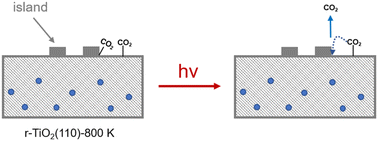
Although TiO2 has been widely used as an efficient photocatalyst, the photocatalytic active sites remain ambiguous. Using rutile TiO2(110) surfaces with well-defined defects, we herein unambiguously identify that edge sites on TiO2 surfaces with interstitial Ti3+ defects are photocatalytically active. On the oxidized TiO2(110) surface with TiO2 islands, chemisorbed CO2 and CO are photo-inactive; on the TiO2(110) surface with surface bridging oxygen vacancies and bulk interstitial Ti3+ defects, CO2 and CO chemisorbed at the vacancy sites become photoactive; on the TiO2(110) surface with TiO2 islands and interstitial Ti3+ defects, CO2 and CO chemisorbed at the edge sites of TiO2 islands are also photoactive. CO chemisorbed at the surface oxygen vacancies shows the highest photo-induced desorption probability, while CO2 chemisorbed at the edge sites of TiO2 islands with interstitial Ti3+ exhibits the highest photo-induced desorption probability. Considering their abundance on powder TiO2 photocatalysts, the edge sites are among the photocatalytic active sites contributing to TiO2 photocatalysis.
 Please wait while we load your content...


