


 PLATFORM UPDATE:


Catalytic ammonia oxidation mediated by high-spin Fe(iii) complex: combined experimental and DFT study

Abstract
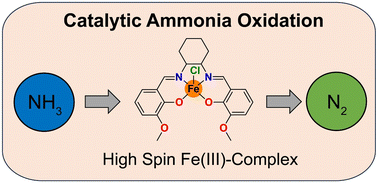
Ammonia offers high hydrogen density and favorable transport properties, making it an appealing hydrogen carrier; yet conventional cracking methods for hydrogen release are energy-intensive. Molecular iron complexes offer a sustainable route for the homogeneous conversion of NH3 to N2 under mild conditions. Here, we describe a high-spin FeIII-complex bearing a tetradentate N,N,O,O-donor trans-1,2-bis(2-hydroxy-3-methoxyphenyl-methaniminyl)cyclohexane ligand framework that catalyzes ammonia oxidation at room temperature. In combination with a triarylaminium oxidant and 2,4,6-collidine base, the catalyst produces up to 2.20 equivalents of N2 per Fe center. Comprehensive characterization of the FeIII-complex by FTIR, UV-vis, XPS, and X-ray diffraction, with Mössbauer and DFT analysis, confirmed its high-spin state. Moreover, DFT studies revealed that N–N bond formation in ammonia oxidation proceeds through nucleophilic attack followed by sequential proton- and electron-transfer steps. Together, these findings underscore the potential of high-spin FeIII-complexes in ammonia oxidation catalysis and provide crucial mechanistic understanding of N–N bond formation.
 Please wait while we load your content...


