


 PLATFORM UPDATE:


ZrO2-promoted highly dispersed Cu–ZnO catalysts for CO2 hydrogenation to methanol under mild conditions

Abstract
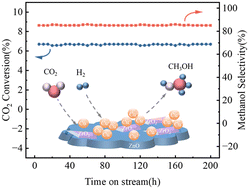
Atmospheric CO2 concentrations are increasing rapidly, posing severe environmental challenges. Hydrogenation of CO2 to methanol represents a promising strategy to reduce the content of CO2. While Cu-based catalysts have garnered significant attention, there are still problems such as low selectivity for methanol and poor stability. In this study, a highly dispersed Cu/ZnO–ZrO2 catalyst was synthesized via a formamide-assisted co-precipitation method. Investigation of the ZrO2 loading revealed that the Cu/ZnO–25%ZrO2 catalyst exhibited optimal performance for CO2 hydrogenation to methanol, achieving a CO2 conversion of 6.7%, methanol selectivity of 85%, and a methanol space–time yield (STY) of 586.5 gMeOH kgcat−1 h−1. The results demonstrate a strong interaction between Cu and the ZnO–25%ZrO2 support surface, which predominantly stabilizes Cu in the Cu+ state. Notably, these Cu+ species remain stable even after reduction and reaction. This interaction not only ensures high catalytic activity but also confers excellent stability to the catalyst, as evidenced by the absence of deactivation over a 200-hour stability test.
 Please wait while we load your content...


