


 PLATFORM UPDATE:


Heterogenous Ni(OH)2/NiOOH redox mediator on bismuth vanadate for photoelectrochemical oxidation of 5-hydroxymethylfurfural
 *a
and
Klaus
Hellgardt
*a
*a
and
Klaus
Hellgardt
*a
Abstract
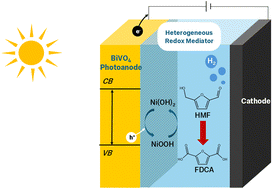
Replacing the kinetically demanding O2 evolution reaction (OER) in photoelectrochemical (PEC) water splitting with the anodic oxidation of biomass-derived 5-hydroxymethylfurfural (HMF) to 2,5-furandicarboxylic acid (FDCA), a key building-block chemical for polymer synthesis, offers a compelling strategy to improve both process efficiency and economic viability of solar-driven H2 production. Although thermodynamically more favourable than the OER, direct HMF conversion is hindered by sluggish kinetics and high overpotential requirement, often necessitating redox mediators such as TEMPO to facilitate the conversion, which however introduces extra cost, process complexity and safety concerns. This study demonstrates that a Ni(OH)2 nanoweb, electrodeposited on BiVO4, functions as an effective solid-state redox mediator via photo-induced formation of NiOOH for PEC HMF oxidation. 48 hours of prolonged operation confirmed the formation of FDCA along with oxidation intermediates. Kinetic analysis revealed an apparent activation energy of 17.2 kJ mol−1 for HMF oxidation by NiOOH, significantly lower than that of conventional thermocatalytic processes. The Ni(OH)2 coating also mitigated photocorrosion of BiVO4, showing excellent stability of the heterostructured photoanode. These findings highlight the dual functionality of the electrodeposited Ni(OH)2 as both a redox mediator for HMF oxidation and a protective layer for the photoelectrode, offering a stable and cost-effective alternative to existing PEC organic valorisation processes.
- This article is part of the themed collections: Catalysis Science & Technology Recent HOT Articles and Catalysis Science & Technology Open Access Spotlight 2025
 Please wait while we load your content...


