


 PLATFORM UPDATE:


Synergistic adsorption–photocatalysis in α-Fe2O3/PDINH Z-scheme heterojunction for efficient azo dye wastewater treatment

Abstract
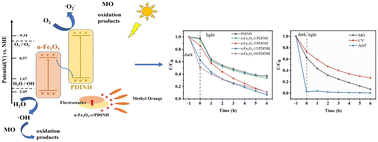
The integration of adsorption and photocatalysis in heterojunction composites offers a promising strategy for efficient azo dye degradation. Here, a novel α-Fe2O3/perylene-3,4,9,10-tetracarboxylic diimide (PDINH) Z-scheme heterojunction was synthesized via a facile solvent method, showcasing synergistic adsorption–photocatalysis for wastewater treatment. Zeta potential analysis (α-Fe2O3: +14.7 mV; PDINH: −24.3 mV at pH 5.0) and density functional theory (DFT) calculations (binding energy: −3.10 eV) revealed strong electrostatic interactions between α-Fe2O3 and PDINH, enabling uniform nanoparticle dispersion and forming a heterostructure with enhanced specific surface area. Electrochemical measurements confirmed that the Z-scheme heterojunction significantly accelerated charge carrier migration and suppressed electron–hole recombination, facilitated by an internal electric field from well-matched band alignment. Under visible light, the α-Fe2O3-15/PDINH composite achieved 93.4% removal of methyl orange (MO), outperforming PDINH alone (63.1%) due to its positive surface charge (+8.7 mV at pH 5.0) that enhanced selective adsorption of anionic dyes. Quenching experiments identified h+, ·O2−, and ·OH as the primary reactive species, with the Z-scheme pathway retaining strong redox capabilities for efficient degradation. Notably, the composite exhibited an operational cost of $2.41 per ton, significantly lower than other reported processes, and maintained high efficiency (81.8% MO removal) over multiple cycles. This work demonstrates that the α-Fe2O3/PDINH composite integrates adsorption and photocatalysis synergistically, providing a low-cost, scalable solution for azo dye wastewater treatment with potential for industrial application.
 Please wait while we load your content...


