


 PLATFORM UPDATE:


Electronic structure modulation of atomically dispersed metal electrocatalysts for the electrocatalytic oxygen reduction reaction

Abstract
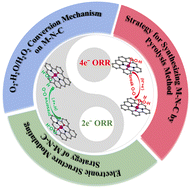
High-efficiency, robust and low-cost electrocatalysts for the oxygen reduction reaction (ORR) are at the heart of new energy conversion and storage devices. Recently, atomically dispersed metal electrocatalysts (metal–nitrogen–carbon, M–N–C) for the ORR have received great attention. Herein, this review presents recent advances in the noble metal-free atomically dispersed metal electrocatalysts toward the ORR. Specifically, we first introduce the different mechanisms of 2e− and 4e− ORR on the catalyst. Then, the classification and corresponding recent advances in M–N–C electrocatalysts are reviewed, including metal coordination configuration (like the structure and coordination of N in M–N4, heteroatom substitution, heteroatom doping in carbon skeleton and axial coordination), modulation of the second atom in diatomic catalysts, and the effect of metal nanoparticles/clusters in M–N–C catalysts. In parallel, the synthesis strategy, structure, electrochemical properties and reaction mechanism are highlighted. Finally, an outlook on the current advances and challenges and the potential of the M–N–C-based electrocatalysts towards 2e− and 4e− ORR are discussed.
 Please wait while we load your content...


