


 PLATFORM UPDATE:


d-Band center modulation in CuNi alloy/graphene oxide catalysts for enhanced electrocatalytic ammonia synthesis from nitrate

Abstract
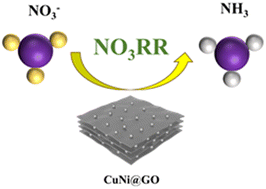
Industrial ammonia (NH3) production is predominantly achieved by the Haber–Bosch process, which consumes substantial energy and emits significant CO2. The electrochemical nitrate reduction reaction (NO3RR) presents a promising alternative to the Haber–Bosch process due to its environmentally benign nature. Developing highly active, selective, and stable electrocatalysts for the NO3RR remains a focal point of contemporary research. In this work, the d-band center of the Cu1Ni1@GO catalyst was strategically modulated via an alloying approach, endowing it with balanced adsorption and desorption capabilities for reaction intermediates. This optimization resulted in exceptional performance, achieving an ammonia yield of 3.47 mg h−1 cm−2 and a Faraday efficiency (FE) of 85.2% at an overpotential of −0.5 V vs. RHE. Theoretical calculations confirmed the d-band center shift in Cu1Ni1@GO and its profound influence on intermediate adsorption dynamics and NO3RR activity, offering crucial insights for the rational design of advanced alloy catalysts. By elucidating the synergistic effect in CuNi @GO composites, this study offers insights for designing efficient catalysts for nitrate reduction to ammonia, with promising applications in sustainable energy and environmental protection.
- This article is part of the themed collection: Catalysis and Materials for Sustainable Energy
 Please wait while we load your content...


