


 PLATFORM UPDATE:


Theoretical screening of P-block single atoms anchored on g-C3N4 for NO reduction to NH3
 c
Xuxin
Kang,
d
Md Tarikal
Nasir,
a
Dimuthu
Wijethunge,
e
Cheng
Yan,
f
Anthony P. O'
Mullane,
f
Hanqing
Yin
*ag
and
Aijun
Du
ag
c
Xuxin
Kang,
d
Md Tarikal
Nasir,
a
Dimuthu
Wijethunge,
e
Cheng
Yan,
f
Anthony P. O'
Mullane,
f
Hanqing
Yin
*ag
and
Aijun
Du
ag
Abstract
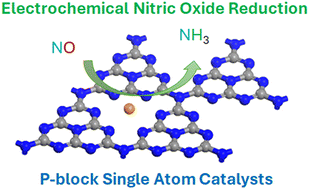
The NO reduction reaction (NORR) is considered an attractive strategy for efficient NO removal and sustainable ammonia (NH3) production. Herein, the catalytic behaviour of eleven p-block single atoms anchored on g-C3N4 monolayer (SAC@g-C3N4, SAC![[double bond, length as m-dash]](https://www.rsc.org/images/entities/char_e001.gif) B, Al, Si, Ga, Ge, As, In, Sn, Sb, Te and Bi) is systematically investigated as NORR electrocatalysts using density functional theory (DFT) calculations. The thermodynamic stability of SAC@g-C3N4 and its suppression of hydrogen evolution were examined. In addition, the thermodynamically favourable reaction pathway was identified based on the Gibbs free energy change, where B@g-C3N4 catalyst exhibited a low limiting potential (UL) of −0.02 V. Furthermore, charge density analysis and projected density of states (PDOS) revealed the origin of NO activation. This work screens pure p-block SAC@g-C3N4 for the NORR and provides an atomic-level understanding of the reaction mechanism. These findings would aid the novel design of NORR catalysts and provide theoretical insights for the experimental synthesis of high-performance electrocatalysts.
B, Al, Si, Ga, Ge, As, In, Sn, Sb, Te and Bi) is systematically investigated as NORR electrocatalysts using density functional theory (DFT) calculations. The thermodynamic stability of SAC@g-C3N4 and its suppression of hydrogen evolution were examined. In addition, the thermodynamically favourable reaction pathway was identified based on the Gibbs free energy change, where B@g-C3N4 catalyst exhibited a low limiting potential (UL) of −0.02 V. Furthermore, charge density analysis and projected density of states (PDOS) revealed the origin of NO activation. This work screens pure p-block SAC@g-C3N4 for the NORR and provides an atomic-level understanding of the reaction mechanism. These findings would aid the novel design of NORR catalysts and provide theoretical insights for the experimental synthesis of high-performance electrocatalysts.
 Please wait while we load your content...


