


 PLATFORM UPDATE:


Functional group translocation: moving functionalities without changing molecular scaffolds

Abstract
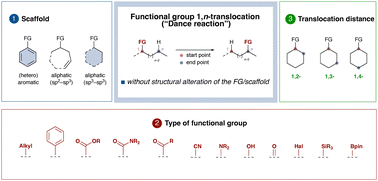
Functional group position plays a decisive role in molecular properties and function, with even subtle positional changes leading to pronounced differences in biological activity, material performance, and reactivity. Access to positional isomers is therefore central to drug discovery and materials chemistry, yet their synthesis has traditionally required independent and often inefficient synthetic routes. Recent advances have given rise to functional group translocation reactions, which enable the direct relocation of functional groups within a molecular framework without altering the underlying scaffold. In this review, we use the term functional group translocation in a narrow sense to describe transformations in which only the bonding position of a functional group changes while the molecular framework and functional group identity remain intact. Such processes offer a concise molecular editing strategy that enables direct access to positional isomers from a common precursor. Enabled by developments in transition metal catalysis and photoredox chemistry, functional group translocation has rapidly progressed beyond classical stoichiometric and substrate-specific processes. This review defines functional group translocation, distinguishes it from traditional rearrangement reactions and broader isomerization processes, and summarizes recent advances across aromatic and aliphatic systems. By organizing the field according to molecular scaffold, functional group identity, and migration distance, this review highlights current capabilities, remaining challenges, and future opportunities in synthesis, drug discovery, and materials chemistry.
 Please wait while we load your content...


