


 PLATFORM UPDATE:


SORS and SESORS: deep Raman spectroscopy in biomedical analysis and disease diagnosis

Abstract
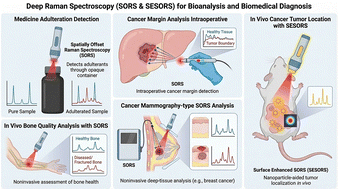
Spatially offset Raman spectroscopy (SORS) and its surface-enhanced variant, SESORS, have emerged as transformative techniques in analytical chemistry and biomedical diagnostics, enabling non-invasive, depth-resolved molecular sensing. SORS facilitates the probing of endogenous signals from subsurface layers, while SESORS enhances sensitivity through plasmonic nanostructures, allowing sensitive targeted detection of exogenous diagnostic agents. Spatially offset Raman spectroscopy is now making significant strides in clinical diagnostics. This review focuses on the rapid advancements in the field over the past five years, including applications in cancer diagnosis, monitoring of therapeutic response, bone health assessment, and tracking of neurotransmitters and SERS-labelled nanoparticles through tissue depths exceeding 7 cm in a tissue wrapped mouse model and 14 cm from within a porcine tissue stack. The integration of tailored nanostructures, resonant Raman labels, and advanced optical instrumentation has expanded the versatility of SESORS, with modalities such as transmission, backscattered, and resonance-enhanced configurations offering flexibility across diverse clinical scenarios. Despite challenges in standardisation, biocompatibility, and instrumentation, interdisciplinary progress in optics, nanotechnology, and spectroscopy continues to drive innovation. This review critically examines the recent evolution, classification, and biomedical applications of SORS and SESORS, highlighting their limitations and future potential in translational medical research.
 Please wait while we load your content...


