


 PLATFORM UPDATE:


Surface-initiated living crystallization-driven self-assembly: from precision nanofabrication to functional interfaces
 †*a
Huibin
Qiu
*a
†*a
Huibin
Qiu
*a
Abstract
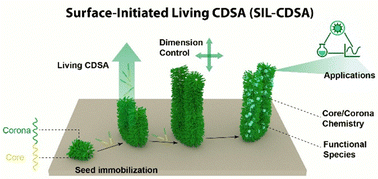
The precise fabrication of nanostructured materials on surfaces is paramount for advancing next-generation technologies in catalysis, electronics, biomedicine, etc. Recently, surface-initiated living crystallization-driven self-assembly (SIL-CDSA) has enabled unprecedented control over the architecture, orientation, and functionality of solid-state nanostructures on desired substrates. This review outlines key principles of SIL-CDSA, including seed immobilization, confined epitaxial growth and micellar brush formation, together with practical methods for dimension control and spatial ordering. Intrinsic core/corona chemistry and the incorporation of exogenous species allowing targeted functionalization are also discussed, covering catalytic, electronic and bioactive features. Case studies are introduced to demonstrate SIL-CDSA as a versatile platform for hierarchically ordered nanostructures, delivering exceptional control over size, periodicity, and composition. By directly translating precision self-assembly to surfaces, SIL-CDSA opens powerful routes to multifunctional, high-performance materials for catalysis, energy systems, sensing, and device fabrication, positioning it as a transformative tool for advanced nanomanufacturing.
- This article is part of the themed collection: 2025 Pioneering Investigators
 Please wait while we load your content...


