


 PLATFORM UPDATE:


Rational design of high-loading electrocatalytic electrodes: from static multiscale integration to dynamic intelligent systems
 *a
and
Lei
Wang
*a
*a
and
Lei
Wang
*a
Abstract
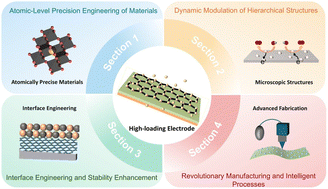
In the field of electrocatalysis, the industrial application of high-loading electrodes faces a fundamental contradiction: traditional designs based on static structures struggle to match the dynamically changing reactive microenvironment and continuously evolving electrode interfaces under real operating conditions, leading to severe performance degradation at high current densities. To address this, this review proposes a paradigm shift from “static multiscale design” to “dynamic intelligent system integration”. This new paradigm integrates dynamically reconstructable materials, bioinspired adaptive architectures, and smart interfaces to construct intelligent electrode systems capable of sensing, adapting, and self-optimizing, thereby synergistically enhancing catalytic activity, stability, and mass transfer under high-loading conditions. The review first analyzes the dynamic failure mechanisms of high-loading electrodes across multiple scales, then follows the thread of “dynamic and intelligent regulation” to summarize key advances at the atomic scale (self-healing and dynamic reconstruction), structural scale (bioinspired and digital twin networks), interface scale (electrolyte and smart interfaces), and manufacturing scale (dry processing and machine learning closed-loop). Throughout this framework, digital twin and machine learning serve as enabling platforms that bridge the entire chain, achieving a closed loop from design and diagnosis to optimization. Finally, future directions such as dynamic evaluation systems, adaptive electrode systems, and green intelligent manufacturing are outlined. This review aims to move beyond traditional static design frameworks and provide systematic design principles and theoretical foundations for developing next-generation electrochemical energy devices with self-sensing, self-optimizing, and long-lasting capabilities.
 Please wait while we load your content...


