


 PLATFORM UPDATE:


Fluorescent dyes in the era of super-resolution imaging: new opportunities, challenges, and evolution
 †ab
Zhaochao
Xu
*ab
†ab
Zhaochao
Xu
*ab
Abstract
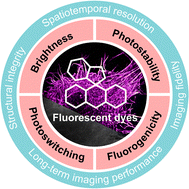
Super-resolution fluorescence imaging (SRI) has redefined the capabilities of optical microscopy, enabling the visualization of biological structures at the nanoscale. This paradigm shift is driven by a unifying principle: achieving spatial resolution by precisely controlling the temporal emission of fluorophores, often referred to as “trading time for space”. This strategy relies fundamentally on the precise modulation of fluorescence emission dynamics, which elevates fluorescent dyes from passive markers to active determinants of imaging performance. This shift represents a historic opportunity for fluorescent dyes, one of the oldest classes of synthetic organic molecules, with SRI reinvigorating and propelling their development into a new era. At the same time, it introduces unprecedented challenges, requiring fluorescent dyes with tailored photophysical properties—such as enhanced brightness, engineered photoswitching kinetics, and superior photostability—that exceed the demands of conventional microscopy. This tutorial review examines how these challenges are driving the evolution of fluorescent dyes. We explore the molecular engineering strategies used to meet the rigorous demands of SRI and discuss how these advancements are pushing the boundaries of SRI technology.
- This article is part of the themed collection: 2025 Pioneering Investigators
 Please wait while we load your content...


