


 PLATFORM UPDATE:


Internally and externally induced chiral hybrid metal halide materials for advanced chiroptoelectronic applications
 a
and
Jialiang
Xu
*a
a
and
Jialiang
Xu
*a
Abstract
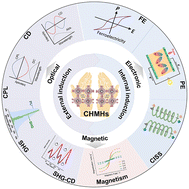
Chiral hybrid metal halides (CHMHs) comprise tunable chiral and noncentrosymmetric structures with remarkable optoelectronic characteristics, offering new avenues for synergistically manipulating the optical, electrical, and magnetic physical degrees of freedom. In these systems, chiral structures act not only as functional scaffolds but also as bridges that link microscopic electronic states with macroscopic optoelectronic behaviors. This review follows a progressive framework to systematically present recent advances in the field of CHMHs, spanning synthetic strategies, physical mechanisms, and device implementations. The chemical routes and transfer mechanisms underlying chiral structure formation are elucidated, with an emphasis on the roles of molecular chirality and external potential field. A central focus is placed on the inherent coupling among linear/nonlinear chiroptical effects, ferroelectric/piezoelectric behaviors, and chirality-induced spin selectivity (CISS) effects, with the “chiral structure-Rashba effect-CISS” chain identified as the key to enabling cross-coupling among spin, charge, and photons. The potential of CHMHs in the detection and emission of circularly polarized light and spin light-emitting diodes is also evaluated, underscoring their irreplaceability in multifunctional integration and magnetic-field-free spin manipulation. This review aims to provide a systematic basis for understanding the structure–function relationships in CHMHs while outlining the strategic direction of opto-electro-magnetic coupling through chirality engineering, thereby laying a foundation for future applications in quantum information platforms and low-power spintronic devices.
- This article is part of the themed collection: 2025 Pioneering Investigators
 Please wait while we load your content...


