


 PLATFORM UPDATE:


Recent advances in solvent effects for biomass-derived platform molecule conversion: experimental and theoretical perspectives
 *ad
and
Buxing
Han
*ad
*ad
and
Buxing
Han
*ad
Abstract
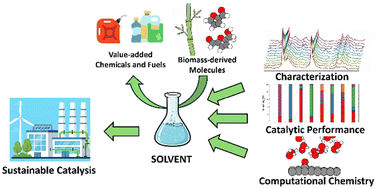
Biomass conversion is a cornerstone of sustainable development, offering renewable and carbon-neutral routes to fuels, chemicals, and materials. Liquid-phase catalytic processes are particularly important for biomass upgrading, as many biomass-derived intermediates are nonvolatile and thermally sensitive. The choice of solvent and its interactions with a catalyst and substrate critically influence the activity and selectivity of these transformations. However, unraveling solvent effects in heterogeneous catalysis is challenging due to the complex solid–liquid interface and dynamic solvent–catalyst interactions. This review examines how solvent selection and molecular interactions dictate reaction pathways in biomass conversion. We highlight how the solvent environment alters reactant adsorption and transition states on catalyst surfaces, and how the solvent itself can participate in reactions. Recently, advanced characterization techniques and computational modeling tools have provided new insights into solvent-mediated mechanisms. This integrated perspective underscores the pivotal role of solvent effects in optimizing biomass valorization and guides future developments in sustainable catalysis.
 Please wait while we load your content...


