


 PLATFORM UPDATE:


Chromium-activated phosphors: from theory to applications

Abstract
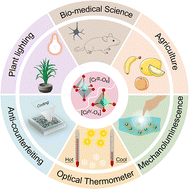
The development of chromium-activated phosphors is essential for applications such as near-infrared (NIR) lighting and in vivo bioimaging. The intra-configurational transition within the 3d orbital of chromium ions, which is susceptible to the surrounding crystal environment, leads to remarkable luminescence tunability from the NIR-I to NIR-II regions. The striking NIR luminescence property makes chromium-activated phosphors a versatile material platform for fundamental optical studies and practical device applications. This review comprehensively summarizes the recent developments in chromium-activated phosphors, encompassing the phenomenological crystal field theories, design principles, materials preparation methodologies, and emerging applications. We delve into the correlation between the local coordination environment (e.g., the geometrical structure of polyhedra, nephelauxetic effect, and interaction coupling) and optical properties (e.g., spectral profile, quantum efficiency, luminescence thermal stability, as well as persistent luminescence and mechanoluminescence), aiming to provide a theoretical basis and experimental guidance for further refinement of chromium-activated phosphors. We also discuss future opportunities and challenges of chromium-activated phosphors, such as extended optical tuning by controlling crystal size and energy level coupling.
 Please wait while we load your content...


