


 PLATFORM UPDATE:


Recent progress in transition-metal-catalysed intermolecular saturated C(sp3)–N(sp3) bond formation reactions

Abstract
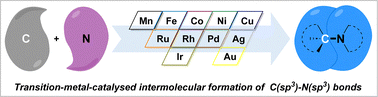
Saturated C(sp3)–N(sp3) bonds are ubiquitous in organic molecules and serve as key subunits in natural products, pharmaceuticals, agrochemicals, and organic materials. Transition-metal-catalysed C–N cross-coupling reactions have evolved as an enabling platform for C–N bond formation, providing an indispensable synthetic tool for the rapid assembly of valuable molecular skeletons. Over recent years, C(sp3)–N(sp3) bond formation has attracted significant attention from the synthetic community, providing straightforward access to sp3-rich C–N bond containing architectures from readily available and cost-effective starting materials. This review highlights recent advances in transition-metal-catalysed intermolecular C(sp3)–N(sp3) bond formation. Key strategies for transition-metal-catalysed C(sp3)–N(sp3) bond formation and mechanistic insights are summarized and discussed. Moreover, ongoing challenges and directions for future opportunities are discussed to inspire further efforts for developing C(sp3)–N(sp3) bond-forming processes.
 Please wait while we load your content...


