


 PLATFORM UPDATE:


Sulfonated porous organic polymers: strategic design, synthesis, and applications in catalysis, adsorption, and energy-related processes
 *a
Saba
Daliran,
*a
Matías
Blanco,
bc
Amarajothi
Dhakshinamoorthy,
d
Unal
Sen,
e
José
Alemán
*bc
and
Hermenegildo
García
*f
*a
Saba
Daliran,
*a
Matías
Blanco,
bc
Amarajothi
Dhakshinamoorthy,
d
Unal
Sen,
e
José
Alemán
*bc
and
Hermenegildo
García
*f
Abstract
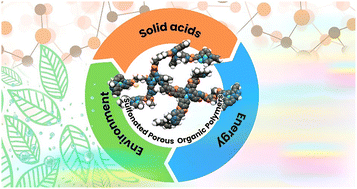
Porous organic polymers (POPs) have become an innovative class of tailor-made materials, encompassing a variety of frameworks that range from highly crystalline to fully amorphous structures such as covalent organic frameworks (COFs), covalent triazine frameworks (CTFs), porous aromatic frameworks (PAFs), conjugated microporous polymers (CMPs), polymers of intrinsic microporosity (PIMs), and hyper-cross-linked polymers (HCPs). While their inherent porosity and stability are impressive, the true strength of POPs lies in strategic functionalization. Among the various methods reported, the incorporation of sulfonic acid (–SO3H) groups in these porous scaffolds introduces additional functionality. This review explores a comprehensive overview of sulfonated POPs (SPOPs), where robust frameworks are combined with the strong Brønsted acidity of –SO3H groups. We describe the design and synthesis of SPOPs, highlighting how this functionalization tailors their properties for innovative applications. Moving beyond their well-known role as superior heterogeneous acid catalysts for organic transformations, SPOPs are now emerging as key materials for addressing global challenges. Their remarkable capabilities are evident in environmental applications, including their deployment as high-performance adsorbents for the removal of dyes, antibiotics, and heavy metals from water, as well as functional porous solids for selective gas separation. We also explore their pioneering applications as next-generation proton-conducting membranes for high-performance fuel cells and advanced energy storage systems, offering alternatives to fluorinated membranes. This review delivers both a critical analysis of the current state-of-the-art and a forward-looking perspective on the challenges and opportunities ahead, serving as a roadmap for leveraging the multifunctional properties of SPOPs to advance sustainable chemistry, environmental remediation, and energy technologies.
 Please wait while we load your content...


