


 PLATFORM UPDATE:


Multifaceted maleimide scaffolds in focus: from synthesis to photophysical applications
 a
Gabriel M. F.
Batista,
bc
Pedro P.
de Castro,
*d
Brenno A. D.
Neto
ef
and
Giovanni W.
Amarante
*a
a
Gabriel M. F.
Batista,
bc
Pedro P.
de Castro,
*d
Brenno A. D.
Neto
ef
and
Giovanni W.
Amarante
*a
Abstract
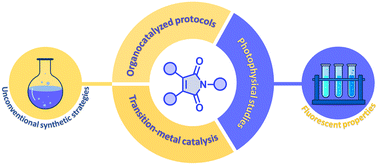
Substituted maleimides, particularly those bearing substitution at the 3- or 3,4-positions, are valuable building blocks in organic synthesis and chemical biology. While classical methods for their preparation rely on halogenated precursors obtained via mono- or dihalogenation of maleic anhydride, these approaches offer limited structural diversity and often require multiple steps. In this work, we highlight recent developments in non-conventional synthetic strategies for accessing 3- and 3,4-substituted maleimides. Special emphasis is placed on methodologies based on transition metal catalysis and organocatalysis, which enable the direct introduction of substituents onto the maleimide core. These advances expand the diversity of accessible structures, facilitating new applications and reactivity profiles. In selected cases, we also discuss how these synthetic routes have led to the development of maleimide derivatives with notable photophysical properties, particularly fluorescence, which may serve in future applications. Overall, this tutorial review provides a comprehensive synthetic perspective on recent advances in the field, aiming to support further innovation in maleimide chemistry.
- This article is part of the themed collection: 2025 Pioneering Investigators
 Please wait while we load your content...


