


 PLATFORM UPDATE:


Progress of surface-modified inorganic phosphors for performance improvement: from methods to applications
 *a
Guogang
Li
*bcd
*a
Guogang
Li
*bcd
Abstract
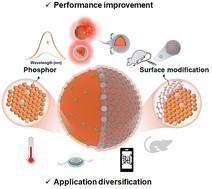
Surface modification strategies exhibit superior interface control capability and functional scalability, which can not only protect the structure and performance stability but also endow the materials with new features. In particular, surface modification plays an important role in performance optimization of inorganic phosphor materials to improve their luminous efficacy, thermal stability, chemical resistance and compatibility. This strategy can promote a wide range of studies in light-emitting diodes, optical sensing, anti-counterfeiting, and biomedical imaging fields. Nevertheless, a profound understanding of the effects of surface modification on the structure and performance of phosphor materials is lacking. This review focuses on the recent advances in surface modification of the inorganic, organic, and organic–inorganic layer coatings of phosphor materials. The design principles, intrinsic structure variations, luminescence performance, underlying mechanisms and applications are comprehensively summarized. Notably, the relationship between interface engineering and luminescence optimization is proposed. Furthermore, we highlight the challenges faced by the coated phosphors in emerging fields and discuss the limitations of the current cladding technologies. This review provides new perspectives for the design of multifunctional phosphor materials with surface modification for advanced emerging platforms, and the proposed interface engineering mechanism offers theoretical guidelines for the performance manipulation of other functional materials.
 Please wait while we load your content...


