


 PLATFORM UPDATE:


Optical probes of hot carriers in halide perovskites

Abstract
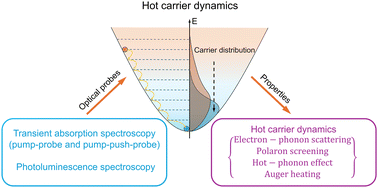
The unusual slow cooling of hot carriers (HCs) in halide perovskites presents a promising route to harvest the excess carrier energy and exceed the Shockley–Queisser (SQ) efficiency limit of single-junction perovskite solar cells. Spectroscopic interrogation of HC dynamics is a crucial step toward an in-depth understanding of the HC properties and underlying cooling mechanisms in these materials. A range of spectroscopy techniques – most notably pump–probe (or transient absorption (TA)) spectroscopy, pump–push–probe spectroscopy, steady-state photoluminescence (PL) and time-resolved PL spectroscopy – have been employed to study HC behaviour. However, variations in experimental implementations and data analyses can lead to conflicting or even erroneous interpretations, impeding meaningful comparisons across studies and hindering progress in the field. This tutorial review provides an overview of the most commonly used optical spectroscopy techniques for probing HC dynamics in the representative halide perovskite systems, detailing the underlying physical principles and models used to extract HC temperatures and cooling rates. We also discuss best practices for experimental design and data interpretation, aiming to minimize methodological pitfalls. By consolidating current approaches and offering guidance for their application, this tutorial serves as a resource for researchers seeking to explore HC phenomena and advance HC-based optoelectronic technologies in emergent semiconductor systems.
- This article is part of the themed collection: Halide Perovskites: Emerging Materials and Innovative Applications
 Please wait while we load your content...


