


 PLATFORM UPDATE:


The edge of halide perovskites: surfaces and interfaces drive solar efficiency and stability
 †a
Michel
De Keersmaecker,
a
Erin L.
Ratcliff
ab
and
Juan-Pablo
Correa-Baena
*ab
†a
Michel
De Keersmaecker,
a
Erin L.
Ratcliff
ab
and
Juan-Pablo
Correa-Baena
*ab
Abstract
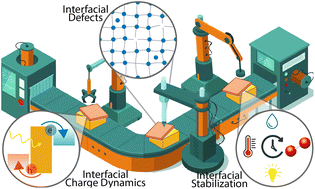
Halide perovskite solar cells (PSCs) have emerged as one of the most promising next-generation photovoltaic technologies, owing to high conversion efficiencies, low fabrication costs, and broad material tunability without significant synthetic effort. Early progress directed material screening to boost efficiencies via compositional and morphological optimization. Outstanding challenges include refined control over parasitic loss pathways, such as surface recombination at charge harvesting electrodes, and long-term stability. In this review, we identify critical design criteria of interfaces to promote both performance and durability. Key points of consideration include near-surface chemistry-electronic property connections underpinning charge harvesting selectivity, how defect-mediated recombination at interfaces lowers device performance, and how interfacial instabilities underlie many failure mechanisms in perovskite solar cells. This review surveys current materials strategies for interfacial engineering, including transport layer design and surface passivation, as well as advanced characterization techniques that offer insights into materials surfaces and buried interfaces. By integrating theoretical understanding with empirical approaches, we aim to provide a framework for rational interface design to unlock scalable, stable, and efficient perovskite photovoltaics.
- This article is part of the themed collection: Halide Perovskites: Emerging Materials and Innovative Applications
 Please wait while we load your content...


